
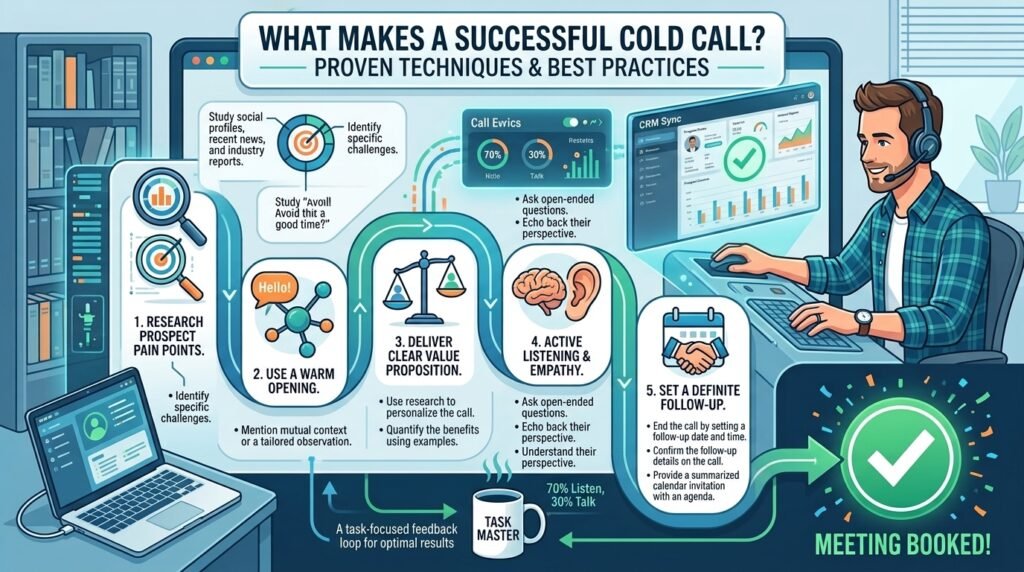
The Quick Answer
A successful cold call is not about closing a deal on the spot. It is about booking the next conversation. The industry average dial-to-meeting rate is 2.3%, meaning roughly 2 to 3 meetings booked for every 100 dials. But top performers achieve 11.3% by combining four key elements: clean data, smart timing, strong openers, and persistent follow-up across multiple channels. Here is exactly how to do it.
Does Cold Calling Still Work in 2026?
Yes. Cold calling still works. But lazy cold calling is dead.
82% of B2B buyers have accepted meetings from salespeople who reached out cold. That is not a small number. That is the majority of buyers admitting that cold outreach works when done right.
The phone has advantages that email and social media simply cannot match. Prospects can delete your email. They can scroll past your LinkedIn message. But a phone call demands a real-time response. You get immediate feedback. You can adjust your approach on the spot. You build human connection faster than any text-based channel.
Over 50% of B2B leads still originate from cold calls. Companies that are growing fast are 42% more likely to include cold calling in their sales strategy. The data is clear. The channel is not broken. The approach is.
What does not work anymore is the spray-and-pray method. Dialing through a random list with a generic pitch and hoping something sticks is a waste of time. Buyers are not allergic to calls. They are allergic to irrelevant, robotic, unprepared calls.
The gap between average and elite is enormous. Top-quartile reps convert conversations to meetings at 3.6 times the rate of average reps. That is not luck. That is process. That is skill. That is what we are going to teach you.
The 4 Pillars of Successful Cold Calling
Every successful cold call rests on four pillars. Miss even one and your results will suffer.
Pillar 1: Data Quality
You cannot succeed with bad data. Verified direct dials and clean lists are the foundation. Calling a cell phone is significantly more likely to result in a pickup than calling a desk phone or a main office number.
Pillar 2: Smart Timing
Call at the right time in the prospect’s time zone. Tuesday and Wednesday are the best days. The late afternoon window of 4 to 5 PM delivers 71% higher success than morning calls.
Pillar 3: Strong Openers
Your first 5 to 10 seconds determine whether you get a conversation or a hang-up. The right opener can multiply your success by over 6 times.
Pillar 4: Multi-Channel Persistence
Calls do not work alone. Combine them with email and LinkedIn. Multi-channel cadences drive 28 to 37% more conversions than phone-only outreach.
About the Author
This guide is written by sales operations experts with over two decades of experience helping B2B companies build outbound sales systems that actually work. We have analyzed thousands of cold calls, trained hundreds of sales development representatives, and worked with companies ranging from startups to enterprises across North America, Europe, and Asia-Pacific markets. Our insights are drawn from real-world implementation, not theory.
Pre-Call Preparation That Doubles Your Success Rate
Most reps fail before they even pick up the phone. Here is how to prepare like a top performer.
Step 1: Segment Before You Dial
Random calling is not cold calling. It is guessing.
The first step is getting your list right. Segment your prospects by title, industry, company size, existing technology stack, or any combination that gives you the most targeted group. The tighter your segment, the more relevant your message can be. The more relevant your message, the higher your conversion rate.
John Barrows, the founder of JB Sales, has been teaching this for 25 years. His rule is simple. Start with targeting. Not scripts. Not tools. Targeting. If you do not know exactly who you are calling and why they should care, nothing else you do will save you.
Spend about one hour each day researching your top-tier target accounts. Look at LinkedIn profiles. Find something specific you can reference to make a direct connection to the value your service can provide.
Call Disposition Tip: After each call, log the outcome. Common dispositions include: Connected, Left Voicemail, Gatekeeper, Not Interested, Call Back Requested, Meeting Booked. Tracking dispositions helps you identify patterns. If you are leaving voicemails without callbacks, your message needs work. If gatekeepers are blocking you, your approach needs adjustment.
Key Point: For every hour of calling, spend at least 10 minutes on research. This is not wasted time. It is the most valuable investment you can make. Consider leveraging virtual assistant services to handle research and data cleaning so your sales team can focus purely on calling.
Step 2: Develop a Targeted Message
Once you have a segment, figure out what those people actually care about. A quick search for “VP of Sales [industry] priorities 2026” will get you there faster than you think.
Then match what you know about their priorities to the outcomes your solution has delivered for similar companies.
Here is a message structure that works:
“[Specific persona] in [specific industry] who’s main priority is [their main priority or challenge] leverage [specific component of your solution] to drive [specific result]. I wanted to see if that is relevant for you.”
That is it. Fifteen seconds or less.
The goal is not to explain your product. The goal is to get the response “How do you do that?” If you can get that response, you are in a conversation. Everything else is noise.
Step 3: Prepare Your Questions and Your Ask
Most reps go into cold calls with a pitch and no questions. That is backwards.
If you have segmented properly and developed a message that speaks to real priorities, you already know what questions to ask. They are not BANT questions. They are specific questions that show you understand what the person is dealing with.
Here is a proven question:
“We are working with other VPs of Sales in your space on three things right now: pipeline quality, AI readiness, and rep ramp time. Which of those is most pressing for you?”
That question works because it is specific, relevant, and invites them to tell you what they actually care about.
The clearest indicator that a rep is not ready to make calls is that they do not know what they are asking for. Are you asking for a referral? A brief call at a later date? A brief conversation now? Decide before you dial. The more specific the ask, the easier it is for the prospect to say yes.
Tip: Always have a micro-commitment ready. A micro-commitment is a small, easy-to-say-yes-to request. “Would you be open to a 15-minute call next Tuesday?” is a micro-commitment. “Can I show you a demo right now?” is not.
The Perfect Cold Call Script
Here are three proven opening scripts backed by data from over 300 million cold calls analyzed by Gong.
The Permission-Based Opener
Success Rate: 11.18%
This opener works because it owns the fact that you are making a cold call and disarms the prospect with brutal honesty.
“Hi [Name], this is [Your Name] from [Company]. I know I’m calling out of the blue. Do you have 30 seconds for me to tell you why I called? Then you can decide if we should keep talking.”
The Social Proof Opener
Success Rate: 11.24%
This is the best-performing opener in Gong’s analysis. It leads with context that shows you have worked with their peers.
“Hi [Name], this is [Your Name] from [Company]. We have been working with companies like yours, and I have heard your name tossed around. The reason I’m calling is…”
The “How’ve You Been?” Opener
Success Rate: 6.6x higher than baseline
This works because it is an unexpected pattern interrupt. It scrambles the prospect’s brain in a good way.
“Hi [Name], this is [Your Name] from [Company]. How have you been?”
Even if you have never talked to the person before, you can plausibly ask this question to a perfect stranger. You will be surprised at how rarely anyone calls you out for it.
The Opener to Avoid
Success Rate: 0.9%
If your first question is “Did I catch you at a bad time?” you are 40% less likely to book a meeting. You are literally inviting the prospect to bail before you have earned a second of attention. Kill this opener immediately.
What to Say After the Opener
Whatever opener you choose, get to your reason for calling quickly. Gong found that calls where reps explicitly say “the reason for my call is…” are about 2.1 times more successful than calls that never do.
Anchor that reason in something specific. A funding event. A hiring spike. A tool rollout. A role-based problem.
The goal of the opening is not to explain your product. The goal is to get the response “How do you do that?” or “Tell me more.” If you can get that response, you are in a conversation.
Discovery Questions That Actually Work
Once you get past the opener, the dynamics shift. Now it is about controlling a conversation, not surviving one.
Successful cold calls average 5 minutes and 50 seconds. Unsuccessful calls average just 3 minutes and 14 seconds. The extra time is spent on discovery, not pitching.
Here are discovery questions that work:
“What is your current process for [relevant activity]?”
“What is the biggest challenge your team faces with [area]?”
“What have you tried to solve this issue so far?”
“How is this issue impacting other parts of your business?”
“If you could change one thing about [current situation], what would it be?”
“What would an ideal solution look like for you?”
The best calls include 11 to 14 discovery questions and are delivered at a steady pace of about 176 words per minute.
Key Point: Ask questions. Then shut up and listen. Take notes as the prospect talks. Use the silence as a tool. Prospects will try to fill the silence, which gets them to open up because they usually deal with salespeople who do not shut up.
6 Common Objections and How to Handle Them
Objections feel like rejection. They are not. They are requests for more information. The best reps welcome them as signals of engagement.
Here is the liberating truth from Gong’s data: most objections are reflexes, not real concerns. The top five most common objections account for 74% of all objections. Master these and you are covered most of the time.
| Objection | Response Framework | Script Example |
| “Not interested” | Agree + Incentivize + Explore | “I expected that might be the case. You get tons of these calls. But every now and then, it makes sense to listen to the right call. Can I share why I called?” |
| “Send me an email” | Ask qualifying questions first | “I don’t want to flood your inbox with irrelevant information. Could I ask you a couple quick questions first, so I can send you something useful?” |
| “No budget” | Explore beyond current constraints | “Would you be open to exploring options beyond what you have now, just so you can have this in your back pocket for future reference?” |
| “Working with competitor” | Differentiate + Create Curiosity | “I know it sounds like you are happy. But would it be a horrible idea to review your options, if your current vendor is unable to help you with [specific improvement]?” |
| “Not a priority” | Uncover what IS a priority | “I completely understand. Priorities can shift quickly. Can I ask what your current top priorities are?” |
| “Timing isn’t right” | Get commitment to future follow-up | “That makes sense. Timing is rarely perfect. When would be a better time for me to reconnect?” |
The LAER Framework:
The most effective objection handling method is the LAER framework:
- Listen to the objection completely
- Acknowledge that you heard them and understand
- Explore to understand the real objection behind the surface response
- Respond with a solution or alternative
Never skip the Explore step. That is where you understand the real objection behind the surface-level response.
Dismissive objections represent 49.5% of all objections. They are the most common knee-jerk reactions to a cold call. The hardest part about dismissive objections is that they are not real objections. You have nothing to work with because you have no idea why they are not interested.
Your job is to get to the real objection. Agree with the objection, incentivize them to tell you more, and then sell the test drive (the meeting). Stay calm, slow down, and keep the pressure low.
Timing and Persistence—The Data
Best Days and Times
The data on timing is remarkably consistent across multiple studies.
Best Days: Tuesday and Wednesday
Best Times:
- 4 to 5 PM — 71% higher success rate
- 10 to 11 AM — Second-best window
- 8 to 9 AM — Also effective
The 5-Minute Window: Call 5 minutes before the hour or half-hour. Prospect calls often end right before the hour. They are more likely to pick up in that window.
Golden Rule: Always call in the prospect’s time zone. Not yours. Stack your highest-priority dials into Tuesday and Wednesday mornings. Save Fridays for follow-ups.
The Persistence Playbook
Most reps give up too early. Here is what the data says.
- 8 attempts — Average number of calls needed to reach a prospect
- 44% — Percentage of sales reps who quit after just 1 attempt
- 93% — Percentage of conversations that happen by the 3rd attempt
- 98% — Percentage of conversations that happen by the 5th attempt
95% of converted leads are reached by the 6th call attempt.
The numbers are clear. Most reps give up before they ever reach the prospect. When you hear a rep say cold calling does not work, ask them how many attempts they made. The answer is almost always “one.”
Key Point: Front-load your persistence. Three attempts in the first week, then taper. Focus your energy on the attempts where most conversations happen.
Gatekeeper Navigation and Voicemail Strategy
The Gatekeeper Mindset
Gatekeepers are not your enemy. They are doing their job. And their job is to filter, not to block.
If their job was to block every call, they would be called wall keepers, not gatekeepers. Gates are meant to open. Your job is to give them a reason to open it.
Do not try to trick your way past a gatekeeper. Faking familiarity. Being deliberately vague. Pretending you have a relationship that does not exist. They spot these tactics immediately, and once they do, you are flagged for every future call.
3 Gatekeeper Approaches That Work
- The Relevance Approach:
“This is [Your Name] with [Company]. The reason I am calling [Decision Maker] is that we are working with other VPs of Sales to help them address pipeline quality and AI readiness. I thought it would be worth a conversation.”
This gives the gatekeeper something concrete to pass along.
- The Trigger Event Approach:
“The reason I am calling [Decision Maker] is that I saw they recently posted about rebuilding their discovery process. That is exactly what we help companies do.”
A gatekeeper who hears a specific reference to something their boss actually said is far more likely to put you through.
- The “Help Me” Opener:
“This is [Your Name] with [Company]. Actually, maybe you can help me. Do you have a moment?”
The word “help” aligns with the mentality of most people in administrative roles. They are wired to help. Ask them what the best way to get on that person’s calendar would be.
Key Point: Have a reason for your call that is specific enough that a gatekeeper can repeat it. If your reason cannot survive being relayed by someone else, your message is not tight enough.
The Voicemail That Gets Callbacks
Yes, leave voicemails. But not for the reason most people think.
The goal of a voicemail is not to get a callback. Almost nobody calls back. The goal is to add another touch and impression point so the prospect connects your name to your email, your LinkedIn profile, and your next call.
The Structure:
- Start with the reason for your call
- Your callback number (said slowly, twice)
- Your name and company at the end
“The reason I am calling is that we are working with other VPs of Sales right now to help them address pipeline quality and rep ramp time. I thought it would be worth a quick conversation. If you get a chance, give me a call back at [your number]. This is [Your Name] with [Company], [your number].”
By putting your name and number at the end, you make the prospect listen to the whole message to find out who is calling. Lead with your name and they delete it two seconds in. Lead with the reason and they hear the full message before deciding.
Key Point: Keep it under 20 seconds. One reason for calling. Your number said twice slowly. Your name and company at the end. That is the whole thing. If you cannot explain why you are calling in one sentence, your message is not tight enough yet.
Multi-Channel Cadence—Calls Don’t Work Alone
The single biggest strategic upgrade you can make is to stop treating cold calling as a standalone channel.
The Layering Effect:
Email first. Call second. LinkedIn third. The channel that gets the meeting is often the call, but the context from the email makes it relevant.
The Lift:
- Calls alongside email and LinkedIn drive 28 to 37% higher conversion rates
- Just adding a call to an auto-email increases meetings booked by 6%
The Winning Model:
- 8 to 12 touches over 2 to 3 weeks
- Interleaved with email and LinkedIn
- Measure conversion by cadence, not by single calls
Structured Sequence Example:
Day 1: Email
Day 2: Call + Voicemail
Day 3: LinkedIn connection request
Day 4: Call
Day 5: Follow-up email
Day 7: LinkedIn message
Day 9: Call + Voicemail
Day 11: Final email
Key Point: Document your sequence so persistence and channel-mixing happen by default, not by individual rep memory. To maximize results, complement your outbound calling with a strong digital marketing strategy that drives inbound leads alongside your cold outreach efforts.
Measuring What Matters—KPIs That Actually Predict Success
If you are not measuring, you are guessing. And if you are guessing, you have no idea whether your message is working, your targeting is off, or your timing is wrong.
Here are the 5 KPIs that separate top performers from the rest.
| KPI | Definition | Benchmark | Why It Matters |
| Connect Rate | Dials ÷ Live Connections | 8-15% | Tells you if your data and timing are working |
| Conversation Rate | Connects ÷ Meaningful Conversations | 10-20% | Measures your opener and approach |
| Dial-to-Meeting Rate | Dials ÷ Meetings Booked | 2.3% avg, 11.3% elite | The ultimate success metric |
| Gatekeeper Conversion | Gatekeeper conversations ÷ Decision-Maker Reach | Varies | Shows if your gatekeeper approach works |
| Show Rate | Meetings Booked ÷ Meetings Held | ~70%+ | Measures quality of meetings booked |
Track These Four Numbers in Order:
- Dials to connects — Tells you whether your timing and phone data are good
- Connects to gatekeepers vs. decision-makers — Tells you whether your data is accurate
- Gatekeeper conversions — Tells you if your reason for calling is strong enough
- Conversations to qualified next steps — Tells you whether your message and questions are working
Key Point: Use the same approach for an entire calling block so your data is clean. If you switch your message halfway through, you cannot tell what worked. Different personas pick up at different rates. Mixing the data together makes all of it useless.
Top-quartile reps convert conversations to meetings at 3.6 times the rate of average reps. That is not luck. That is process. That is measurement and iteration.
Conversation Intelligence and AI Tools
Modern cold calling is increasingly supported by conversation intelligence tools. These platforms analyze call recordings to provide actionable insights that drive improvement.
How Conversation Intelligence Helps:
- Opener Analysis: Identifies which openers are working and which are failing
- Objection Detection: Flags common objections so you can prepare better responses
- Talk-to-Listen Ratio: Measures whether you are dominating the conversation or letting prospects speak
- Competitor Mentions: Tracks when prospects mention competitors
- Next-Step Compliance: Checks whether you are consistently securing next steps
Popular conversation intelligence platforms include tools that integrate with CRMs and power dialers. These platforms analyze thousands of calls to identify winning patterns that individual reps might miss.
Practical Application: Use conversation intelligence to identify your top-performing reps’ best practices and then share those patterns across the entire team. If one rep consistently books more meetings, find out what they are doing differently and teach it to everyone else.
Key Point: Technology amplifies good process. It does not replace it. A conversation intelligence tool cannot fix bad data or a weak opener. But it can help you identify and fix those problems faster.
The Psychology of Successful Cold Calling
Here is the mindset shift that changes everything about cold calling:
You are not selling your product or service on a cold call. You are selling time. You are selling the next step.
The second you try to pitch your product on a cold call, you lose. The prospect did not ask for this call. They do not have 20 minutes to hear about your platform. What they might have is 30 seconds to hear why a follow-up conversation could be worth their time. That is what you are selling.
The AIDA Framework Applied to Cold Calling
Attention: The first 5 seconds. Practice your intro until it is automatic. You either earn the next 25 seconds or you do not.
Interest: Ask a question or deliver a very short value proposition that makes them want to hear more. Something specific to their role or industry that signals you are not reading from a generic script.
Desire: Get them engaged in the conversation. They are responding. Asking a question back. Telling you about their situation. This is the moment the call shifts from interruption to dialogue.
Action: The ask. And the ask is never “Can I show you a demo?” The ask is time. A brief call later this week. An intro to someone else on their team. A meeting to go deeper. Something small, specific, and easy to say yes to.
Small Language Tweaks, Big Results
The words you choose matter more than you might think.
- Using “we” and “our” instead of “I” and “my” increases meeting bookings by 35%
- Using collaborative language like “ourselves” and “us” also improves results
- “We have helped companies like yours solve…” positions you as a partner with a track record
- “I can help you solve…” positions you as a lone salesperson pushing product
The Interest CTA vs. The Specific CTA
According to Gong, the “interest CTA” beats the “specific CTA” on cold calls because you are selling the conversation, not the meeting.
Try a line like:
“Does it make sense for me to give you more detail about how we do that?”
Rather than jumping straight to:
“Are you free Tuesday at 4?”
That said, once interest is established, get specific. Always propose a concrete time. Never leave it open-ended. “I will get back to you” is an unacceptable outcome. The likelihood of a prospect actually getting back to you is about 1 in 100.
Call Recording
Recording your calls is the fastest way to improve. Most reps have no idea what they actually sound like.
One hour of listening to your own calls will show you more than any training course. Listen for whether your message is clear, whether you are asking real questions or filling dead air, and whether you are actually listening to what the prospect says or waiting to deliver the next line.
Do that honestly and you will know exactly what to work on.
Key Point: Confidence is built through repetition and practice. You cannot read confidence from a script. You have to rehearse until it is automatic. A 7-day practice sprint can transform your delivery.
How Aesyrix Helps Businesses Master Cold Calling
At Aesyrix, we understand that cold calling is just one piece of a complex sales puzzle. Since 2000, we have been helping B2B companies build the infrastructure they need to succeed.
Our mission is simple: Empowering Innovation, Simplifying Technology.
We work with companies of all sizes—from startups to enterprises—to streamline their sales operations and maximize their outbound results.
Our Services
CRM Setup and Management: A well-organized CRM is the foundation of successful cold calling. We help you set up and optimize your CRM to track every interaction, measure every KPI, and keep your data clean.
Lead Generation: We find and qualify the right prospects so your team spends time talking to decision-makers, not chasing dead leads. This complements our cold calling services to build a complete outbound engine.
Virtual Assistant Staffing: Free your sales team from administrative tasks. We provide virtual assistants who handle data entry, research, and follow-up so your SDRs can focus on what they do best—calling and closing.
Digital Marketing and Lead Generation: We drive high-quality leads to your business through targeted digital marketing strategies that complement your outbound efforts, including SEO, AEO, and GEO services that attract inbound prospects while your team focuses on outbound calling.
Automation Services: We automate repetitive tasks so your team can focus on high-value activities.
Why Choose Aesyrix?
- Established Expertise: Over two decades of experience in sales technology and operations
- Global Reach: We serve clients worldwide with a deep understanding of different markets
- Customized Solutions: Every business is different. We tailor our approach to your specific needs and goals
- Proven Results: We have helped hundreds of companies streamline their sales operations and increase revenue
Note: Pricing for our services varies based on your location, market, and specific requirements. We encourage you to contact our team for a personalized quote and to learn about current pricing and available options tailored to your business needs.
Frequently Asked Questions About Cold Calling
How many cold calls should I make per day?
For most B2B reps, 30 to 50 targeted dials per day is the right baseline when you are combining calls with email and LinkedIn. Quality matters more than volume. If you are at 100 dials and getting nothing, the problem is not the number of calls. It is the targeting and the message.
What is a good cold call success rate?
It depends on which metric you are measuring. The dial-to-meeting rate averages 2.3% industry-wide. Top-performing teams hit 5 to 8%. Elite performers can reach 15% on a good list with a tight script.
If you are at 1% or below, something structural is broken. Usually your data, your targeting, or your opener. If you are at 4% or above, you are already beating the average. If you are hitting 8% or above, you are in the top tier of B2B outbound.
What is a good cold call connect rate?
A good connect rate is roughly 15 to 25% of dials reaching a live person. Cognism’s 2025 data shows about a 16.6% average connection rate, meaning roughly 1 in 6 call attempts reaches someone.
Of those connects, roughly half become meaningful conversations. That means about 1 in 10 call attempts results in a conversation with a prospect.
Verified mobile direct dials can cut dials needed to connect from 19 to just 8. Data quality is the biggest lever you are ignoring.
What is the best time to make cold calls?
The best days are Tuesday and Wednesday. The best time windows are 4 to 5 PM (71% higher success) and 10 to 11 AM in the prospect’s time zone.
Early morning, 8 to 9 AM, is also effective. Midday is the worst time because everyone is either in a meeting or at lunch.
What is the best cold call opener?
The data from Gong’s analysis of 300 million calls shows three winning options:
- “How’ve you been?” — 6.6 times higher success
- The Social Proof Opener — 11.24% success rate
- The Permission-Based Opener — 11.18% success rate
Avoid the “Did I catch you at a bad time?” opener. It makes you 40% less likely to book a meeting with a dismal 0.9% success rate.
How many attempts does it take to reach a prospect?
Sales reps need an average of 8 calls to reach a prospect. Meanwhile, 44% of reps give up after just one attempt.
93% of conversations happen by the 3rd attempt. 98% happen by the 5th attempt.
Do not give up too early. Most conversations happen after multiple attempts. Front-load your persistence. Three attempts in the first week, then taper.
Should I leave voicemails?
Yes. But leave them strategically. The goal is not to get a callback. Almost nobody calls back. The goal is to add another touch and impression point so the prospect connects your name to your email, LinkedIn, and future calls.
Put the reason for your call FIRST. Put your name and number LAST. Keep it UNDER 20 SECONDS. One clear reason. Your number said twice slowly. Your name and company at the end.
Does cold calling still work?
Yes. Cold calling still works in B2B when done correctly. 82% of buyers have accepted meetings from cold outreach. Over 50% of B2B leads still originate from cold calls. High-growth companies are 42% more likely to include cold calling in their sales strategy.
What does not work is lazy, unprepared, irrelevant calling. The channel is not broken. The approach is.
How do you handle cold call objections?
Use the LAER Framework:
- Listen to the objection completely
- Acknowledge that you heard them and understand
- Explore to understand the real objection behind the surface response
- Respond with a solution or alternative
Most objections are reflexes, not real concerns. Dismissive objections represent 49.5% of all objections. Your job is to get to the real objection. Agree with the objection, incentivize them to tell you more, and then sell the test drive (the meeting).
Should I cold call or cold email?
Both. Cold calling works best when layered with email and LinkedIn. Calls alone have a place. Email alone has a place. But calls + email + LinkedIn drive 28 to 37% higher conversion rates than single-channel outreach.
Use email to provide context. Use the call to engage in real-time conversation. Use LinkedIn to reinforce your message and build social proof.
Key Takeaways
Successful cold calling is not magic. It is a repeatable process.
- Segment your list before you dial. Random calling is guessing.
- Develop a targeted message that is 15 seconds or less. Get the prospect to ask “How do you do that?”
- Prepare your questions and know your CTA before you dial.
- Use proven openers. “How’ve you been?” “Permission-based.” “Social proof.” Never ask “Did I catch you at a bad time?”
- Handle objections with the LAER framework. Most objections are reflexes, not real concerns.
- Call at the right time. Tuesday and Wednesday. 4 to 5 PM. 10 to 11 AM. Always in the prospect’s time zone.
- Be persistent. It takes an average of 8 attempts to reach a prospect. 44% of reps quit after 1 attempt.
- Layer your outreach. Calls + Email + LinkedIn = 28 to 37% higher conversion.
- Measure what matters. Connect rate. Conversation rate. Dial-to-meeting rate. Gatekeeper conversion. Show rate.
- Shift your mindset. You are not selling your product on a cold call. You are selling time. You are selling the next step.
Ready to Transform Your Cold Calling Results?
Cold calling is a skill. It can be learned. It can be practiced. It can be perfected.
But it is also part of a larger system. Data. CRM. Lead generation. Follow-up. Automation. All of these pieces need to work together to create predictable, repeatable pipeline growth.
That is where Aesyrix comes in.
We have been helping B2B companies build the infrastructure they need to succeed since 2000. From CRM setup and lead generation to virtual assistant staffing and automation, we provide the tools and support you need to turn cold calling from a chore into a competitive advantage.
Contact us today to learn how we can help you build a cold calling system that actually works.