Building a website typically takes anywhere from one day to over a year. The exact timeline depends on five key factors: the type of website you need, who builds it (DIY, AI, freelancer, or agency), the features you require, whether your content is ready, and how quickly decisions get made.
Here is a quick snapshot of what to expect:
| Website Type | DIY Timeline | Professional Timeline |
| Simple Landing Page | 1-3 days | 3-5 days |
| Portfolio or Brochure Site | 1-3 weeks | 2-4 weeks |
| Small Business Website | 1-2 weeks | 4-8 weeks |
| E-commerce Store (Small) | 3-6 weeks | 8-12 weeks |
| Large E-commerce Store | 2-3 months (DIY) | 4-8 months |
| Custom Web Application | Not recommended | 6-12+ months |
Fact #1: The #1 reason website projects get delayed is not technical issues—it is waiting for content like text, images, and videos. In fact, content delays account for nearly 90% of all project slowdowns.
Now let us break down exactly how long each part of the process takes, why timelines vary so much, and what you can do to get your website live faster without sacrificing quality.
What Actually Determines Your Website Timeline?
Before you can plan your launch date, you need to understand what is driving the clock. Five factors will shape your entire project schedule.
1. Who Builds Your Website
Your choice of builder changes everything.
AI Website Builders like Wix AI or Elementor AI can generate a fully functional site in minutes. You can have a basic business site up and running in just a few hours. However, you will still need time to customize the design, add your branding, and tweak the content.
DIY Website Builders such as Wix, Squarespace, Weebly, and Webflow give you more control but take more time. A simple site might take a few days, while a more complex business site could take several weeks, especially if you are learning the tool as you go.
Freelancers and Independent Developers typically take 4 to 12 weeks for a standard business website. They work faster than a solo DIYer because they have experience, but they are still just one person juggling design, development, and revisions.
Full-Service Agencies like Aesyrix bring an entire team to your project. You get dedicated designers, developers, project managers, and content specialists working in parallel. While this may sound like it takes longer, an experienced agency often delivers a better-quality, more complex site faster because tasks happen simultaneously rather than one after another. Aesyrix has delivered over 14,000 projects globally, with 25+ years of combined expertise, ensuring your project moves efficiently from start to finish. Our website development services are designed to deliver custom solutions that scale with your business.
Key Tip: If you want to launch fast without compromising quality, a professional agency is your best bet. They manage the entire process so you can focus on running your business.
2. Website Type and Complexity
A simple landing page is not the same as a fully custom web application. Here is the reality:
- Landing Page: Just a few sections. No complex navigation. Quick to build.
- Portfolio Site: A handful of pages to showcase your work. More structure, but still straightforward.
- Small Business Website: 5 to 15 pages including blog, contact forms, and maybe a booking system.
- E-commerce Store: Product pages, shopping cart, checkout, payment gateways, shipping rules, and tax logic.
- Corporate Website: Dozens of pages, multiple departments, stakeholder approvals, and brand consistency across everything.
- Custom Web Application: This is not just a website. This is software. User authentication, subscriptions, custom dashboards, API integrations, and complex backend logic.
The more pages and features you add, the longer your timeline becomes.
Fact #2: A typical website has a lifespan of just 2 years and 7 months. This means planning for the long term—scalability, maintenance, and ongoing updates—is just as important as the initial launch.
3. Features and Integrations
Every feature you add extends your timeline. Some of the biggest time-consumers include:
- User authentication and login systems
- Payment gateways like Stripe or PayPal
- Third-party API integrations (CRMs, email marketing tools, inventory systems)
- Custom product filtering and search
- Multilingual support
- Subscription and membership functionality
- Booking and scheduling systems
Each of these requires design, development, testing, and often third-party coordination. A feature that sounds simple—like “I just want users to log in”—can actually add weeks of work when you consider authentication, security, session management, and password recovery.
4. Content Readiness
Fact #3: Content delays are the number one cause of missed launch dates. If your copy is not final, your images are not selected, and your product data is not organized, your project will stall.
The most successful projects treat content preparation as a parallel workstream. Start writing your copy and gathering your visuals before the design phase even begins. This single action can compress your timeline by weeks.
5. The Decision-Making Process
Here is a harsh truth: how fast you make decisions matters as much as how fast your team works. A solo founder can approve a design mockup in an hour. A committee of ten stakeholders might take two weeks to agree on the same thing.
Appoint a single decision-maker for your project. Consolidate feedback into clear, structured rounds. Avoid vague comments like “make it pop.” Specific, actionable feedback speeds everything up.
Key Tip: Create a “must-have” vs. “nice-to-have” list before development begins. Launch with the essentials and add advanced features later. This keeps your timeline tight and your budget under control.
Website Development Timeline by Type
Now let us get specific. Here are realistic timelines for the most common website types, broken down by who builds them.
Simple Landing Page (1 to 5 Days)
A landing page is the fastest type of website to build. It serves one purpose for one audience. Product launch pages, event registration pages, and PPC campaign landing pages all fall into this category.
If your content is ready and you have a clear design direction, a landing page can go live in a single day using a website builder. Even custom designs usually take just 3 to 5 days.
Key Point: Landing pages are quick because they have no backend logic, no multi-page navigation, and no complex integrations. Just a hero section, a clear call-to-action, some social proof, and a contact form.
Portfolio or Brochure Website (1 to 4 Weeks)
Portfolio websites for creatives, photographers, designers, and freelancers typically include an About page, a portfolio gallery, a services page, and a contact page. They are straightforward but require more content organization than a single landing page.
Using a template on Wix or Squarespace, you can launch in 1 to 2 weeks. A custom portfolio with unique visual design and interactive project displays will take 2 to 4 weeks.
Small Business Website (4 to 8 Weeks)
This is the sweet spot for most local businesses, service providers, and startups. A typical small business site includes:
- Home page
- About page
- Individual service or product pages
- Blog section
- Contact page with inquiry form
- Basic SEO setup
- Mobile optimization
- Google Analytics and Search Console integration
A team like Aesyrix can build a custom small business website that is search-engine friendly, conversion-focused, and scalable for growth. Our website development services combine technical expertise with strategic planning to deliver results. With a clear plan and your content ready, this timeline is very achievable.
E-commerce Website (2 to 6 Months)
E-commerce development is a significant step up. Whether you are building on Shopify, WooCommerce, Magento, or BigCommerce, the technical requirements are extensive.
Beyond designing the storefront, you need to:
- Upload and organize product data
- Configure payment gateways
- Set up shipping rules and tax logic
- Build product filtering and search functionality
- Test the checkout process thoroughly
Key Tip: Product count is the single most variable factor in e-commerce timelines. A store with 50 products can launch in 8 to 10 weeks. A store with 500 products across multiple categories, with custom filtering and third-party inventory integration, can take 4 months or more.
Fact #4: Studies show that 75% of users judge a company’s credibility based on its website design. Investing the right amount of time in your e-commerce store directly impacts trust and sales.
Corporate Website (6 to 12 Weeks)
Corporate websites serve larger organizations with multiple departments, multiple stakeholders, and a sitemap that may span dozens of pages.
The complexity comes from the organizational layer on top of the technical build. Custom UI/UX design aligned with brand guidelines, advanced CMS structure for different teams to manage their own content, and a multi-stakeholder approval process all extend the timeline.
In corporate projects, the approval cycle is consistently the most significant source of delays. A design that a small team would approve in two days can take two weeks when it needs sign-off from multiple departments.
Custom Web Application (6 to 12 Months)
A custom web application is not a website in the traditional sense. SaaS platforms, CRM systems, booking marketplaces, and multi-sided platforms are software products that happen to run in a browser.
They are built with modern tech stacks like React, Node.js, .NET, and Python. They require:
- Architecture planning
- API design
- Database engineering
- Custom dashboards
- Multi-user role systems
- Comprehensive QA and security testing
Key Point: Six to nine months is a realistic window for a well-scoped MVP of a custom web application. Larger platforms with complex functionality or significant integrations can take even longer. Any estimate shorter than this for a genuinely custom application should be treated as a red flag.
Aesyrix builds custom web applications, SaaS platforms, mobile apps, and enterprise systems with scalable architecture and long-term reliability. Our team uses modern frameworks like Laravel, React, Next.js, and Node.js to deliver solutions that grow with your business. Explore our software development services to see how we can bring your vision to life.
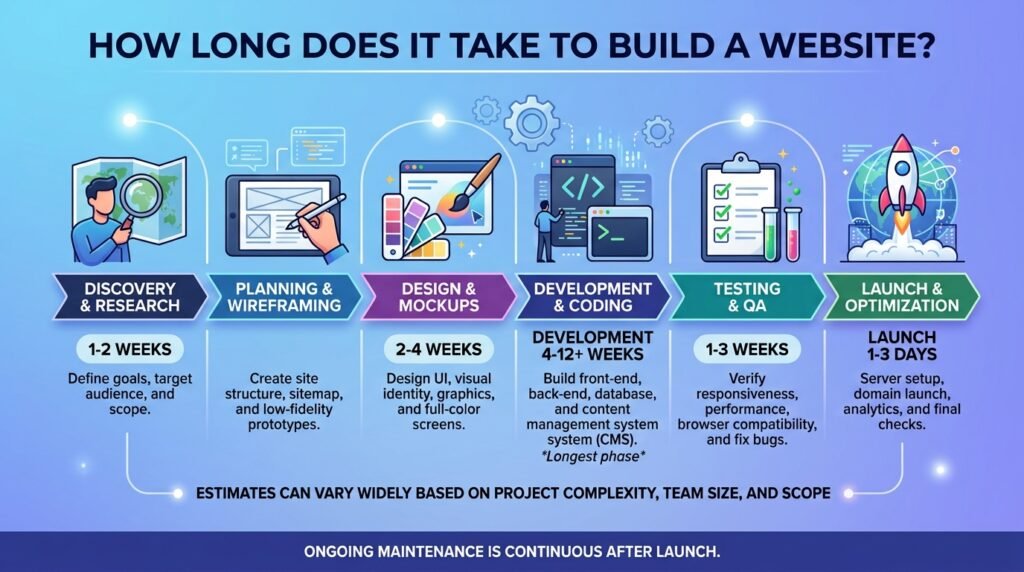
The 6 Phases of Website Development: Where the Time Actually Goes
Understanding the development lifecycle helps you see exactly where time is spent and where delays often happen.
Phase 1: Discovery and Planning (1 to 3 Weeks)
This is the most important phase. A house built without a blueprint will collapse. A website built without a strategy will fail.
During discovery, your development team answers key questions:
- Who is this site for?
- What do you want visitors to do?
- What defines success?
- Who are your competitors?
- What content do you need?
The output is a clear project brief or scope document. Skipping or rushing through discovery is one of the most reliable predictors of project delays and budget overruns.
Aesyrix’s Approach: Our discovery phase involves learning your goals, challenges, and vision. We map scope, timeline, and deliverables before any coding begins. This clarity is what allows us to deliver projects on time, every time.
Phase 2: UI/UX Design (1 to 4 Weeks)
Design transforms your requirements into a visual blueprint. It typically involves two steps:
Wireframing creates low-fidelity, black-and-white blueprints that define where each element lives on each page. This is about usability, not aesthetics. Resolving structural problems at the wireframe stage costs hours. Resolving them after design can cost days or weeks.
Mockups then bring the wireframes to life with color, typography, imagery, and branding. You review these high-fidelity designs and provide feedback.
The length of this phase depends almost entirely on the number of revision rounds. A decisive client with a clear brand direction can move through design in one week. A project with multiple stakeholders and evolving creative direction can extend this to four weeks.
Key Tip: Consolidate all design feedback into a single round. And always provide specific, actionable feedback. “I don’t like this button” is not helpful. “Please make the call-to-action button more prominent and use our brand blue color” is very helpful.
Phase 3: Development and Build (2 to 8 Weeks)
This is where the designs become a functional, live website.
Frontend development builds each page layout in code, implements responsive behavior across screen sizes, integrates the CMS, and adds animations or interactive elements. This is the part users see and interact with.
Backend development covers everything that happens behind the scenes: database architecture, admin panel configuration, payment gateway integration, CRM and API connections, and any custom logic that powers dynamic features.
Not every project needs extensive backend work. A simple informational site with a contact form may have very little. But e-commerce sites, membership platforms, and custom web applications live and die by their backend architecture.
Aesyrix builds with modern, scalable technologies including Laravel, React, Next.js, Node.js, PHP, Python, Flutter, React Native, and .NET. For CMS and no-code needs, we work with WordPress, Shopify, and Webflow. And for cloud and DevOps, we leverage AWS, Azure, Google Cloud, and Docker. Our mobile app development services extend this expertise to iOS, Android, and cross-platform solutions.
Phase 4: Content Population (1 to 3 Weeks)
This is where all that placeholder text gets replaced with your real content.
Copywriting for every page, image sourcing and optimization, and organizing product data all happen here.
Fact #5: The average lifespan of a website is 2 years and 7 months. A well-built, well-maintained site can last much longer, but only if the content is compelling, accurate, and regularly updated.
Key Tip: Image optimization is crucial but often skipped. You cannot upload a 5MB photo directly to your website. It must be resized and compressed for the web to keep your site fast.
Phase 5: Testing and Quality Assurance (1 to 2 Weeks)
Your site looks done, but it is not. Now you need to try to break it.
Cross-browser and device testing ensures the site looks good and works correctly on Chrome, Firefox, Safari, and Edge, as well as on various phones, tablets, and desktops.
Functional testing verifies that all links work, contact forms actually send emails, and the checkout process functions properly.
Performance testing checks how fast the site loads on different connections.
Security testing scans for vulnerabilities and ensures compliance with standards like SSL and PCI.
Accessibility testing ensures the site is usable by people with disabilities, including those using screen readers or other assistive technologies.
User Acceptance Testing (UAT) involves real users testing the site to validate that it meets business requirements and works as expected in real-world scenarios.
Fact #6: Up to 80% of all bugs can be caught during the QA phase if proper testing is conducted. Skipping testing or rushing through it is a high-risk decision, especially for e-commerce sites where checkout failures directly impact revenue.
Aesyrix’s quality assurance process rigorously tests everything before it ships. We ensure your website is fast, secure, accessible, and ready for real users.
Phase 6: Launch and Deployment (1 to 3 Days)
The big day. This phase involves moving the site from development to the live server.
Tasks include:
- Connecting the domain
- Configuring hosting
- Installing SSL certificate
- Setting up Google Analytics and Search Console
- Running a final check on the live environment
For most projects, this takes one to two days. DNS propagation, server migration complexities, or last-minute content changes can extend this to three days.
Why Websites Get Delayed: The 3 Biggest Bottlenecks
1. Content Delays
We have said it before, but it is worth repeating: content is the #1 bottleneck.
You can have the world’s best designer and developer, but if they are waiting on you for the “About Us” text or your product photos, the project will grind to a halt.
Key Tip: Start writing your copy and organizing your images on Day 1 of your project. Treat it as a core deliverable from the very beginning. If you have the budget, hire a professional copywriter to speed things up.
2. Scope Creep
Scope creep is the gradual addition of features, pages, or requirements that were not part of the original project scope.
Individual additions often seem small in isolation. But cumulatively, they can add weeks to a project.
Key Tip: Create a clear scope document before development begins. Include a formal change request process for anything added after work starts. Stick to your “must-have” list. Everything else can wait for future updates.
3. Slow Approvals and Feedback
How quickly do you provide feedback? A designer who waits three days for approval on a mockup just lost three days.
Key Tip: Appoint a single point of contact on your team with the authority to make decisions. Consolidate feedback from all stakeholders into clear, actionable items. Provide feedback within 24 to 48 hours whenever possible.
How to Speed Up Your Website Build Without Cutting Corners
1. Choose the Right Development Partner
A professional team like Aesyrix brings experience, structure, and accountability to your project. With 25+ years of expertise and over 14,000 projects delivered, we know how to avoid common pitfalls and keep your project on track. Our website development services are built around your goals, ensuring a smooth and efficient process.
2. Use a Proven Technology Stack
Modern tools speed up development. React and Node.js enable faster iterations. Laravel provides a robust framework for backend development. Headless CMS architectures offer flexibility for content-heavy sites. JAMstack approaches can improve performance and security. Aesyrix uses the right technology for each project—proven, scalable, and future-ready.
3. Prepare Your Content in Advance
This single action has more impact on your launch date than any other. Have your text and images ready before the design phase begins.
4. Start with a Professional Foundation
Do not reinvent the wheel. Using a high-quality template or starter kit gives you a solid starting point. Your time goes into customization, not creation from scratch.
5. Limit Revision Rounds
Two to three structured rounds of feedback are usually enough. More than that and you risk “revision hell”—endless tweaks that delay the project and rarely produce meaningful improvement.
6. Embrace AI for Planning and Ideation
AI can accelerate the early planning phase by helping you brainstorm ideas, organize content, and validate your website strategy. Use it to identify the pages your website needs, define a logical information architecture, and generate initial wireframes or prototype mockups.
7. Adopt an Agile Methodology
Agile development with two-week sprints allows you to launch core features quickly and iterate based on feedback. This approach helps you get a working product live faster while continuing to improve it over time.
8. Maintain Clear Documentation
A well-documented project with clear specifications, design handoffs, and developer instructions reduces miscommunication and keeps everyone aligned. Proper documentation can cut weeks from your timeline.
Post-Launch: The Work Is Just Beginning
Launch day is the starting line, not the finish line.
After launch, your website requires ongoing care:
Maintenance and Security: Regular security scans, software updates, and backups are non-negotiable. This includes security patches for your CMS, plugins, and server infrastructure.
Content Updates: A blog that has not been updated in two years looks abandoned. Keep your content fresh and relevant to maintain search rankings and user engagement.
Marketing and Growth: SEO, paid ads, social media, and email marketing are how you attract visitors and convert them into customers. Aesyrix’s digital marketing services are designed to grow visibility, capture demand, and turn attention into revenue. Our SEO, AEO & GEO services help you rank higher and reach the right audience. Our social media marketing services build brand awareness and drive engagement across all major platforms.
Performance Monitoring: Core Web Vitals, load times, and user behavior should be tracked continuously. Regular performance audits ensure your site stays fast.
Fact #7: SEO takes 3 to 6 months to start showing significant results. Launch is just the beginning of your online growth journey. Continuous optimization and content creation are essential for sustained visibility.
Aesyrix provides ongoing support, optimization, and growth services beyond launch. We maintain, improve, and scale what we build so your results keep compounding over time. Our cold calling services and virtual assistant services complement our software development to give you a complete growth engine under one roof.
Frequently Asked Questions
Can a website really be built in one day?
Yes, but only for very simple projects. A single landing page built on a website builder like Wix or Squarespace can go live in one day if your content is ready and your design direction is clear. One-day builds are not realistic for e-commerce, membership sites, or any project requiring custom design, integrations, or complex functionality. Aesyrix builds custom websites and web applications that require proper planning, design, development, and testing—typically measured in weeks or months.
How long does it take for a beginner to build a website?
A beginner can build a simple website in 1 to 3 days using a drag-and-drop website builder like Wix or Squarespace. However, learning the tool, choosing a design, and creating content will take longer for a first-time builder. A more complex business site could take a beginner several weeks. If speed is critical, consider working with a professional team like Aesyrix who can guide you through the process and deliver a high-quality result quickly.
How long does it take to build an e-commerce website?
A small e-commerce store with 10 to 50 products can be built in 3 to 6 weeks by a DIY builder or 8 to 12 weeks by a professional team. A large store with hundreds of products, custom filtering, and third-party integrations can take 4 to 8 months. The biggest variable is product data migration and organization. Aesyrix has extensive experience building e-commerce solutions that sell more, with custom integrations for inventory, payments, and shipping.
Should I use a website builder or hire a developer?
It depends on your goals. Website builders (Wix, Squarespace, Shopify) are fast and affordable for simple projects. They are great for landing pages, portfolios, and small business sites with standard features. Hiring a developer or agency is the right choice for custom design, complex functionality, integrations, e-commerce, and long-term scalability. Aesyrix offers the best of both worlds—expert development with transparent communication and affordable pricing—so you get a custom solution without the usual headaches. Our website development services are tailored to your specific needs.
How much does it cost to build a custom website?
The cost of building a custom website varies significantly based on your location, market, team choice, project scope, features, and complexity. A simple brochure site costs much less than a large e-commerce store or custom web application. Aesyrix offers custom solutions tailored to your goals and budget. For a personalized quote and to learn about current pricing and available options, contact our team for a free consultation.
How long does WordPress website development take?
A simple WordPress website built on a customized template typically takes 2 to 4 weeks. A custom WordPress build with unique design, advanced page templates, and third-party integrations takes 4 to 8 weeks. The timeline depends heavily on the number of pages, the complexity of the design, and content readiness. Aesyrix builds custom WordPress sites that are fast, secure, and easy to manage.
How long does it take for SEO to work on a new website?
SEO typically takes 3 to 6 months to show significant results, and sometimes longer for highly competitive industries. Search engines need time to crawl, index, and evaluate your new website. Aesyrix’s SEO, AEO & GEO services are designed to grow visibility, capture demand, and turn attention into revenue over the long term.
How long does website testing take?
Website testing typically takes 1 to 2 weeks for a standard business website, and 1 to 4 weeks for more complex e-commerce or custom web applications. Testing must cover cross-browser and device compatibility, functional testing, performance optimization, security scanning, accessibility compliance, and user acceptance testing. Aesyrix tests rigorously before anything ships, ensuring a smooth, bug-free launch.
What is the difference between a static and dynamic website?
A static website has fixed content that does not change unless manually updated. They are faster to build and load but harder to update. A dynamic website pulls content from a database and can display different content to different users. They are more complex to build but more flexible and functional. E-commerce stores, membership sites, and blogs are typically dynamic. Aesyrix builds both static and dynamic solutions depending on your needs.
How can I get my website built faster?
Three things will speed up your project more than anything else:
- Have all your final content (text and images) ready before the project begins
- Appoint a single person with the authority to make decisions and provide feedback
- Work with an experienced team like Aesyrix that manages the entire process in parallel, not one task at a time
Ready to Build a Website on a Realistic Timeline?
At Aesyrix, we have been helping businesses worldwide build websites, custom software, and digital marketing campaigns for over 25 years. With more than 14,000 projects delivered and a 98% client satisfaction rate, we know what it takes to launch on time—and what causes projects to stall.
We bring senior talent across engineering, marketing, and operations under one roof. Our dedicated teams learn your business, communicate transparently, and deliver results you can measure. Whether you need a simple landing page, a complex e-commerce store, or a fully custom web application, we are ready to help.
Get a free consultation and a clear timeline for your project. Our team will learn your goals, challenges, and vision, then map a clear plan with realistic milestones and deliverables. Contact Aesyrix today to get started.
This guide was brought to you by the experts at Aesyrix. With 25+ years of combined expertise, we have delivered over 14,000 projects globally, helping businesses grow with custom software development, digital marketing, virtual assistants, cold calling, and business process outsourcing. We are your growth partner in tech and marketing.