Choose cross-platform development if you have a limited budget (under $100k), need to launch on both iOS and Android quickly (3-6 months), and your app doesn’t require heavy graphics or intensive hardware access. React Native and Flutter are excellent choices for most business apps, MVPs, and internal tools.
Choose native development if performance is critical, you need full access to device hardware (camera, GPS, biometrics), your app involves gaming, AR/VR, or on-device AI, or you have the budget ($150k+) and timeline (8-12+ months) to build separate iOS and Android apps.
The 2026 Reality: For approximately 80% of business applications, the performance difference between modern cross-platform frameworks and native apps is imperceptible to end users. The “hybrid” approach—using cross-platform for 80% of your app and native modules for the 20% that needs peak performance—is increasingly the winning strategy.
Fact #1: Flutter holds approximately 46% of the cross-platform market share and has over 170,000 GitHub stars, making it the most popular cross-platform framework in 2026.
Fact #2: Cross-platform development can save you 30-40% on initial development costs compared to building two separate native apps.
1. Introduction: The Mobile App Dilemma in 2026
Mobile apps have become essential for modern business. With 2.87 million apps on Google Play and 1.96 million on the App Store, your app needs to stand out—and that starts with choosing the right development approach.
Whether you’re a startup founder validating an idea, a product manager balancing budget and features, or a CTO planning for long-term scalability, the decision between native and cross-platform development is one of the most important you’ll make. It affects your budget, your timeline, your team structure, and ultimately, your users’ experience.
Aesyrix, with 25+ years of expertise and over 14,000 projects delivered, has helped businesses worldwide navigate this exact decision through our comprehensive software development services. Our 98% client satisfaction rate reflects our commitment to building apps that meet business goals—whether native or cross-platform.
This guide provides a data-driven, step-by-step framework to help you choose the right path for your project.
2. Understanding the Core Technologies
What is Native App Development?
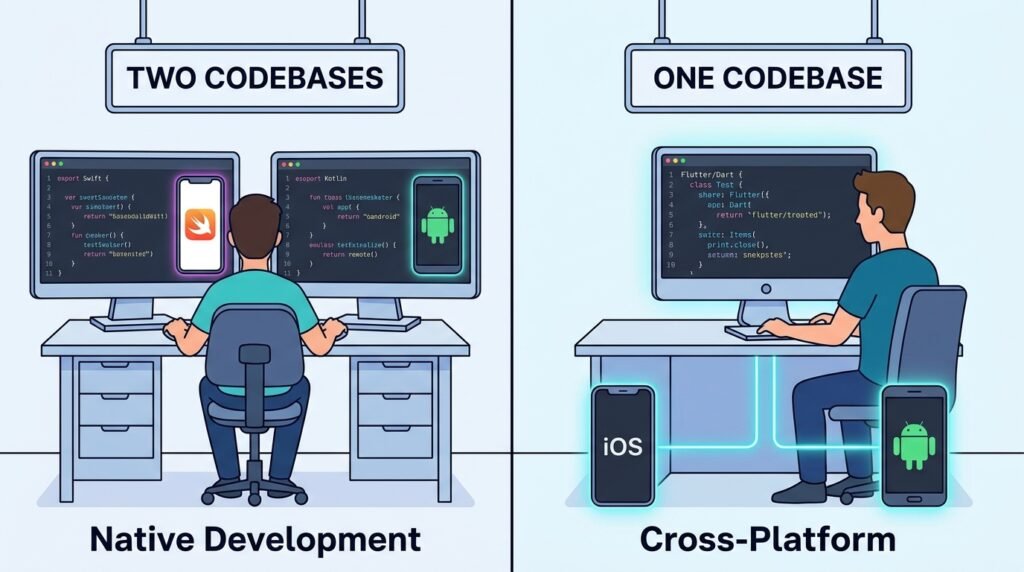
Native app development means building an application specifically for one operating system—either iOS or Android. These apps are written in the platform’s native programming languages and use platform-specific development tools.
For iOS: Developers use Swift or Objective-C with Xcode as the integrated development environment (IDE). Apple’s Human Interface Guidelines (HIG) ensure the app feels like an integrated part of the iOS ecosystem.
For Android: Developers use Kotlin or Java with Android Studio. Google’s Material Design Principles guide the user experience.
Real-world examples: WhatsApp, Spotify, Instagram, Google Maps, and Uber are all native apps that leverage platform-specific features for optimal performance.
Key point: Native apps have direct access to device hardware—camera, GPS, microphone, biometrics, and more—without any intermediary layer.
Fact #3: Kotlin Multiplatform compiles to platform formats—JVM bytecode for Android and native binaries for iOS. The performance of shared code is the same as if written natively.
What is Cross-Platform App Development?
Cross-platform development allows you to build a single application that runs on both iOS and Android from a shared codebase. Instead of maintaining two separate codebases, developers write code once and deploy it to multiple platforms.
Popular frameworks:
| Framework | Language | Key Strength |
| Flutter | Dart | Pixel-perfect UI, custom design, Google-backed |
| React Native | JavaScript/TypeScript | Huge ecosystem, Meta-backed, aligns with React web teams |
| Kotlin Multiplatform | Kotlin | Share business logic, keep native UI; JetBrains-backed |
| .NET MAUI | C# | Microsoft ecosystem integration |
| Ionic | HTML/CSS/JavaScript | Web-based approach |
Real-world examples: Shopify and Discord use React Native. Alibaba and Google Ads use Flutter. Bitkey by Block uses Kotlin Multiplatform to share 95% of its mobile codebase.
Fact #4: On Glassdoor, there were 457 Android developer jobs versus only 58 Flutter developer vacancies in the U.S. However, with Kotlin Multiplatform, you can hire an Android developer who can quickly adapt to cross-platform development since it uses the same Kotlin language.
Hybrid vs Cross-Platform: Know the Difference
A hybrid app is essentially a web application wrapped in a native container (WebView). It uses HTML, CSS, and JavaScript inside a native shell. While it can run on multiple platforms, performance is significantly slower, and access to device features is limited.
Hybrid apps are suitable for simple applications, prototypes, or internal tools—not for production-grade consumer apps.
Cross-platform apps, by contrast, compile to native code or use native rendering engines. The user experience is much closer to native.
3. The 2026 Decision Framework: Side-by-Side Comparison
1. Performance Benchmarks
Performance is often the first concern when choosing between native and cross-platform. Here are the actual numbers:
Cold Start Time (time to launch):
- Native: 0.6 – 1.2 seconds
- Flutter: 0.9 – 1.5 seconds
- React Native: 1.2 – 2.0 seconds
UI Responsiveness: Modern frameworks like Flutter (with the Impeller engine) and React Native (with the Fabric architecture) deliver smooth 60-120Hz animations that are indistinguishable from native for most users.
Key point: For approximately 80% of business apps (CRUD, forms, dashboards, maps, e-commerce), the performance difference is imperceptible to end users. Only gaming, AR/VR, real-time camera processing, and heavy on-device AI truly require native performance.
Fact #5: React Native’s New Architecture delivers 43% faster cold starts and 40x faster bridge communication compared to the previous architecture.
2. Cost & Timeline Analysis
Development Costs:
Cross-platform development can save you 30-40% on initial development costs compared to building two separate native apps.
- Cross-Platform MVP: $40,000 – $150,000
- Native Dual-Platform: $60,000 – $280,000
Development Timeline:
- Cross-Platform: 3 – 6 months
- Native (both platforms): 8 – 12+ months
Total Cost of Ownership (TCO): Remember to factor in hiring costs, team size, maintenance, and framework upgrades. Cross-platform requires a single team. Native requires two specialized teams.
Pricing Note: Actual pricing varies based on your location, market, and specific project requirements. Contact Aesyrix for a personalized quote and current pricing through our mobile app development services page.
3. User Experience (UX) & Design
Native: Provides seamless, platform-specific UX. iOS apps follow Apple’s Human Interface Guidelines. Android apps follow Google’s Material Design Principles. Users get a familiar, intuitive experience.
Cross-Platform: Flutter offers pixel-perfect UI consistency across platforms. React Native uses native UI components for a more platform-native feel. For brand-first apps where visual consistency is more important than platform-specific nuances, cross-platform is excellent.
Key point: If your brand’s visual identity depends on exact UI consistency across platforms, Flutter is a strong choice. If you want each platform to feel authentically “native,” consider React Native or the native approach.
Fact #6: iOS users are more likely to spend money on apps than Android users, with iOS generating significantly higher revenue per user. This is why reaching both platforms is often ideal.
4. Access to Native Features & Hardware
Native: Full, immediate access to all device APIs—camera, GPS, NFC, Bluetooth, biometrics (Face ID, Touch ID), ARKit/ARCore, CoreML/ML Kit, and more. No waiting for framework updates.
Cross-Platform: Access is mediated through plugins or bridges. While modern frameworks can access most features, the latest OS features often arrive 6-18 months later than in native development.
The Verdict: If your app relies heavily on hardware features (AR/VR, real-time camera processing, biometric authentication), native is the clear winner.
5. Security
Native: Access to the latest platform-specific security features, including file encryption, biometric authentication, and fraud detection. Native apps also have lower App Store/Google Play rejection rates for UX inconsistencies.
Cross-Platform: Security depends on the framework and plugins used. With proper implementation, cross-platform apps can be secure, but they rely on additional abstraction layers that could introduce vulnerabilities.
Fact #7: Native apps are recommended for fintech, healthcare, and any application handling sensitive data due to their superior security primitives.
6. Scalability & Maintenance
Native: Easier to optimize for platform-specific performance at scale. However, you must maintain two separate codebases—doubling the effort for updates, bug fixes, and feature additions.
Cross-Platform: A single codebase means easier maintenance and faster updates. However, framework upgrades can be challenging, and you risk vendor lock-in.
The 80/20 Hybrid Strategy: The 2026 winning strategy for many companies is building 80% of the app cross-platform for speed and cost efficiency, then developing native modules for the 20% of features that require peak performance.
Fact #8: Teams using Kotlin Multiplatform often share 90-95% of their mobile codebase while keeping platform-specific implementations where necessary.
7. The 2026 X-Factor: AI Integration
AI is transforming mobile apps, and this is where the native vs cross-platform decision gets interesting.
Cloud-Based AI (Chatbots, Recommendations, Image Recognition): Works seamlessly with both approaches. You make standard HTTP requests to APIs, and both frameworks handle the communication well.
On-Device AI (Real-Time ML, CoreML, ML Kit, TensorFlow Lite): Native provides a significant advantage. Apple Intelligence and Gemini Nano are integrated directly into the OS, giving native apps a 6-18 month lead on new AI features.
AI-Assisted Development: Cross-platform frameworks are increasingly well-suited for AI-assisted development workflows. Tools like Flutter AI DevTools and React AI Kit simplify the integration of AI features.
Fact #9: If AI is your app’s core value proposition, native development gives you a strategic advantage in 2026. However, if you need rapid prototyping of AI features, cross-platform accelerates iteration.
8. Wearables & Extended Devices
In 2026, apps often need to extend beyond phones to smartwatches, tablets, TVs, and other devices.
Native: Each platform has its own ecosystem—watchOS for Apple Watch, Wear OS for Android smartwatches, tvOS for Apple TV, Android TV. You build separately for each.
Cross-Platform: Flutter and React Native are expanding to support wearables and desktop platforms, but support is still evolving. Kotlin Multiplatform can share business logic across all device types.
The Verdict: If you plan to extend to multiple device types from the start, native is currently more mature. For a phone-first approach, cross-platform works well.
9. Progressive Web Apps (PWAs) as an Alternative
A Progressive Web App is a website that behaves like a mobile app. It can be installed on a user’s home screen, works offline, and sends push notifications.
Pros: Cheapest and fastest to build. No app store approval needed. Works on any device with a browser.
Cons: Limited access to device hardware. iOS support is more restricted than Android. Not suitable for complex apps.
When to choose PWA: Simple applications, content-heavy apps, e-commerce stores, or when you need the broadest possible reach with minimal budget.
4. How to Choose: A 6-Step Decision Guide
Step 1: Define Your Target Platforms
- Targeting only iOS or only Android? Native simplifies development.
- Targeting both? Cross-platform reduces duplication.
Step 2: Assess Performance Requirements
- Gaming, AR/VR, real-time camera/ML? Choose native.
- CRUD apps, forms, dashboards, e-commerce? Cross-platform is excellent.
Step 3: Evaluate Your Team’s Expertise
- React/JavaScript team? React Native is a natural extension.
- Kotlin team? Kotlin Multiplatform lets you leverage existing skills.
- Swift/Objective-C team? Native iOS may be the best path.
Step 4: Set Your Budget & Timeline
- Budget under $100k, timeline under 6 months? Cross-platform.
- Budget $150k+, timeline 8+ months? Native is viable.
Step 5: Plan for AI and Future-Proofing
- On-device AI is core? Native gives you a competitive edge.
- Cloud-based AI? Either approach works well.
- Multiple device types? Consider native for full ecosystem support.
Step 6: Choose Your Framework
- Flutter: Best for pixel-perfect, brand-consistent UI; ideal for custom visual design.
- React Native: Best for teams with React/TypeScript experience; broad ecosystem.
- Kotlin Multiplatform: Best for sharing business logic while keeping native UIs; ideal for teams with Kotlin experience.
- .NET MAUI: Best for Microsoft-centric teams.
5. Decision Flowchart: Visual Guide
[Decision Flowchart Image Description]
Start → Need both iOS and Android?
→ No → Native (Choose iOS or Android)
→ Yes → Is performance critical? (Gaming, AR/VR, heavy AI?)
→ Yes → Native (Build separate iOS and Android apps)
→ No → Is budget under $100k or timeline under 6 months?
→ Yes → Cross-Platform (Choose Flutter, React Native, or KMP)
→ No → Hybrid Approach (80% Cross-Platform + 20% Native Modules)
6. When to Choose Native App Development
Choose native development if:
- Your app requires peak performance (gaming, AR/VR, video editing)
- You need full, immediate access to device hardware and platform APIs
- Security is critical (banking, healthcare, fintech)
- You want a premium, platform-specific user experience
- Budget and timeline are not constraints
- You plan to support wearables and extended devices from day one
7. When to Choose Cross-Platform App Development
Choose cross-platform development if:
- Time to market is essential
- You have a limited budget
- You need to reach both iOS and Android users simultaneously
- Your app doesn’t require heavy processing or advanced native features
- You want code reusability and simpler maintenance
- You’re building an MVP to validate your idea
8. When to Consider PWAs
Consider a Progressive Web App if:
- You have a very limited budget
- Your app is content-heavy rather than feature-heavy
- You want to avoid app store approval processes
- You need maximum reach across all devices
- Your app doesn’t require advanced hardware access
9. The Hybrid Reality: 80/20 Strategy
The 2026 landscape reveals a pragmatic truth: many successful apps use a hybrid approach.
- Build 80% of the app using cross-platform frameworks (core features, business logic, UI)
- Build 20% of the app with native modules (performance-critical features, deep hardware integration)
This approach gives you the speed and cost benefits of cross-platform development while maintaining native-level performance where it matters most.
Example: A social media app could build its core features (profiles, feeds, messaging) using React Native, then implement the camera and AR filters using native modules for optimal performance.
Fact #10: Many companies start with cross-platform for speed and cost, then gradually adopt native components as they grow—just like Airbnb did.
10. Case Studies: Real-World Examples
Native Success: WhatsApp
WhatsApp serves over 2 billion users with frequent calls and media sharing. Native development ensures reliable performance, deep hardware integration, and platform-specific features like push notifications and encryption.
Why Native: Performance and security at scale.
Cross-Platform Win: Shopify
Shopify, the leading e-commerce platform, uses React Native to maintain consistency across iOS and Android while accelerating feature development.
Why React Native: Faster iterations and a single codebase.
The Migration Story: Airbnb
Airbnb initially used React Native to move fast. As the company grew, performance and developer experience became priorities. They gradually returned to native development.
Takeaway: Different phases of growth may require different approaches. Choosing cross-platform first doesn’t lock you in forever.
Aesyrix’s Cross-Platform Success
Aesyrix delivered a polished iOS and Android cross-platform app that reached 100K downloads in its first quarter. Our cross-functional teams work across frameworks—Flutter, React Native, Kotlin Multiplatform—to choose the right tool for your goals through our mobile app development services.
Client Testimonial: “Aesyrix rebuilt our platform and took over our marketing in the same quarter. Reliable, responsive, and genuinely results-driven.” — Daniel Meyer, CEO
11. Frequently Asked Questions (FAQs)
Q: Which is better: native or cross-platform?
A: There’s no single “better” option. It depends on your project’s needs. Native excels in performance and access to device features, while cross-platform offers cost and time-to-market efficiency. For approximately 80% of business applications, modern cross-platform frameworks deliver performance indistinguishable from native.
Q: Can cross-platform apps achieve native performance?
A: Modern frameworks like Flutter (with the Impeller engine) and React Native (with the Fabric architecture) deliver “near-native” performance. For most applications—e-commerce, social media, productivity, B2B SaaS—the difference is negligible for end users. However, for gaming, AR/VR, and heavy on-device AI, native still leads.
Q: How much does it cost to build a cross-platform vs native app?
A: Cross-platform MVP typically costs $40,000 to $150,000, while building two native apps ranges from $60,000 to $280,000. Cross-platform can save 30-40% on initial development costs. Actual pricing varies based on location, market, and specific requirements.
Contact Aesyrix through our mobile app development services page for a personalized quote tailored to your project needs and current market rates.
Q: What if I choose cross-platform but need native features?
A: You can use the “hybrid” or “80/20” strategy: build the core of the app cross-platform and develop native modules for specific performance-critical features. This approach is increasingly common in 2026.
Q: Is Kotlin Multiplatform better than Flutter or React Native?
A: It depends on your goals:
- Kotlin Multiplatform for sharing business logic while keeping 100% native UI
- Flutter for pixel-perfect UI consistency and custom visual design
- React Native for the vast JavaScript ecosystem and React alignment
All are valid choices in 2026.
Q: How does AI impact the native vs cross-platform decision?
A: For cloud-based AI, both work well. For high-performance, on-device AI using Apple Intelligence or Gemini Nano, native provides a significant advantage with 6-18 months lead on new features. If AI is your app’s core value, native gives you a competitive edge.
Q: Can I switch from cross-platform to native later?
A: Yes. Many companies start with cross-platform for speed and cost, then gradually adopt native components for performance-critical features or eventually migrate entirely. The key is to design your architecture with clear boundaries between shared logic and platform-specific code.
Q: What are Progressive Web Apps (PWAs) and are they a good alternative?
A: PWAs are websites that behave like mobile apps—they work offline, send push notifications, and can be installed on a home screen. They are the cheapest and fastest to build but have limited hardware access. PWAs are best for content-heavy apps, e-commerce stores, or when you need maximum reach with minimal budget.
Q: How do I choose between Flutter and React Native?
A: Choose Flutter if you need pixel-perfect UI consistency, custom visual design, and are comfortable with the Dart language. Choose React Native if your team already knows React/TypeScript, you need a larger ecosystem, or you plan to share code with a web application.
Q: Is it worth building an app for both iOS and Android?
A: Yes. Android has a larger global user base (71% market share), while iOS users tend to spend more on apps. Reaching both platforms maximizes your potential audience and revenue. Cross-platform development makes this cost-effective.
12. Conclusion: Your Next Step
The decision between native and cross-platform app development comes down to your business goals, budget, timeline, and technical requirements.
Fact #11: The 2026 answer is: “Cross-platform by default for speed and cost, native by design for strategic performance and AI.”
At Aesyrix, with 25+ years of expertise and 14,000+ projects delivered, we guide businesses through this exact decision. Our teams are proficient in Flutter, React Native, Kotlin Multiplatform, Swift, and Kotlin—ensuring we recommend the right tool for your goals, not just the one we’re comfortable with, through our comprehensive software development services.
Whether you need a cross-platform MVP to validate your idea, a native app with peak performance, or a hybrid approach combining both, we deliver with transparency, security, and measurable results.
Ready to Bring Your App Idea to Life?
Contact Aesyrix for a free consultation. We’ll learn your goals, assess your requirements, and map a clear plan with timelines and deliverables through our mobile app development services. No generic playbooks—just custom solutions built for your success.
What you get with Aesyrix:
- ✅ 25+ years of combined expertise
- ✅ 14,000+ projects delivered
- ✅ 98% client satisfaction
- ✅ Cross-functional teams across engineering, marketing, and operations
- ✅ Transparent reporting and honest timelines
- ✅ 24/7 support across 60+ countries
With 98% client satisfaction and clients across 60+ countries, Aesyrix is your growth partner in tech and marketing. Let’s build something great together.